Kang Ye-won Says It Best: She Prefers Supercars to Jewelry—And These Four Travel Fits Prove It
At 47, the actress turned variety star just casually reinvented how to dress for travel. Four outfits from Shanghai and Hangzhou that prove you don't need labels if you understand contrast.
- One statement element per outfit—blazer, dress, or skirt—and everything else supports it
- Use neutral colors when the background is bold, bold colors when the background is neutral
- Repeat one accessory color throughout (hat, bag, shoes) to create visual continuity

Kang Ye-won broke through as the girl from Haeundae, which was basically the biggest film moment, and she pivoted from serious acting into prestige thrillers and the indie circuit. These days though? She's become a household name through Disrespectful to My Mom where she brings this chaotic, unfiltered energy that has everyone obsessed. She went to Hanyang University for vocal performance and apparently went to school with actor Cho Seung-woo, which is a fun trivia piece if you're into that stuff. She's 47, has that thing where she doesn't care what people think, and apparently she'd rather flex about driving nice cars than wearing nice bags. (Her words, basically.) The fact that she's building this whole personality around 'I love cars, not jewelry' is exactly the energy we didn't know we needed. Anyway, we got four vacation looks from Shanghai and Hangzhou and they're worth talking through because they're honestly teaching us something.
Let's break down the four looks and what they're actually showing us.
GREY OVERSIZED BLAZER AGAINST PINK SUPERCAR: How Neutral Dressing Steals the Scene
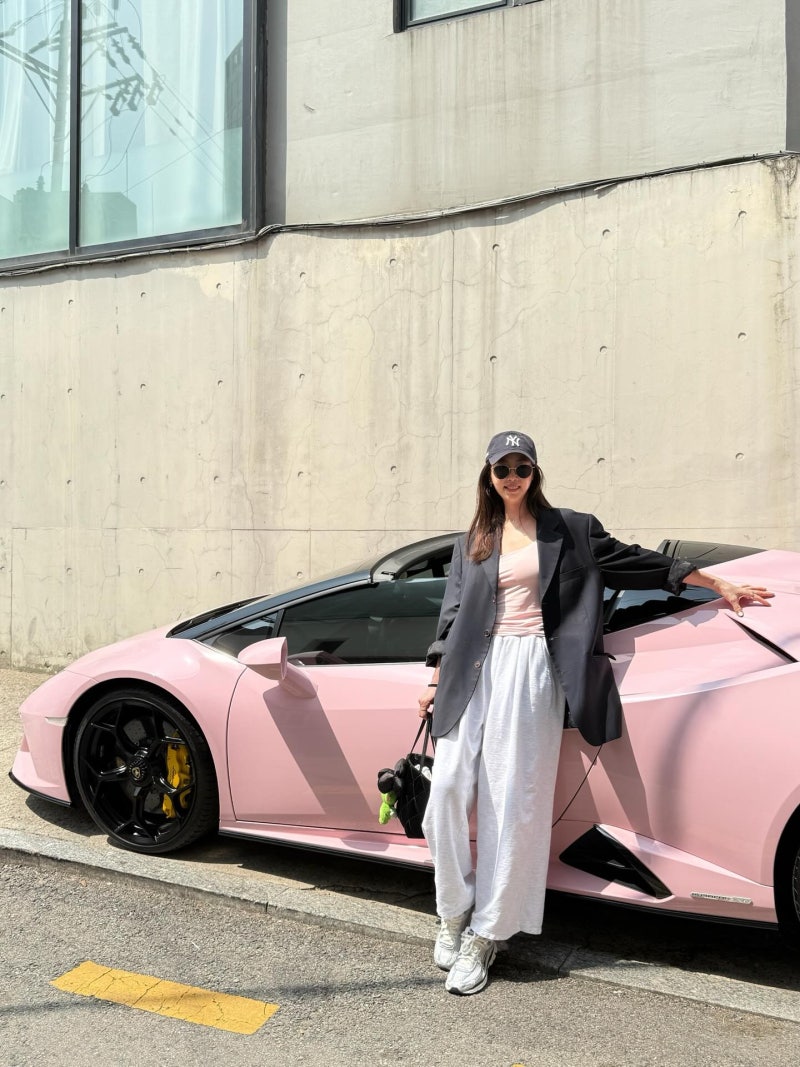
First look is the one that set the internet on fire. Grey oversized blazer, pale pink crop top underneath, white wide-leg pants, white sneakers, navy ball cap, sunglasses—all against a hot-pink sports car. Here's the thing most people mess up: when you're posing next to something visually loud (like a hot-pink supercar), if you dress loud too, nobody knows where to look. Kang went the opposite direction. She made herself the neutral zone, and suddenly the car becomes her backdrop instead of her competitor.

The blazer is doing the heavy lifting. It's oversized enough to feel comfortable but structured enough that it's not sloppy. You can wear an oversized jacket with a graphic tee and look homeless, or pair it with clean basics and suddenly you're fashion-forward. She picked clean basics (white pants, sneakers), so the jacket reads as intentional. That little pink top peeking through creates a color whisper instead of a color scream. White pants keep everything airy. Add a ball cap and sunglasses at face level and suddenly she's got this casual confidence thing happening where she looks like she's just rolled up somewhere amazing and she's not even trying.
The lesson: oversized blazer goes casual when you pair it with sneakers, not heels. Take any outfit you think is boring and throw an oversized structured jacket on top and suddenly it's got weight and intention. She's teaching us that comfort and looking put-together aren't opposites.
ADIDAS JERSEY DRESS: Sporty Doesn't Have to Mean Casual
Second look is this Adidas white jersey dress with navy side stripes. The stripes run vertically along the sides, which is exactly how you elongate a silhouette. White base, navy line, super clean. She's added pearl necklaces—multiple strands layered, which is the reversal that makes it work. A sporty dress without any jewelry would read as 'I'm going to the gym.' Add delicate pearls? Suddenly it's fashion.
The navy ball cap echoes the stripe color and keeps the blue story going. Delicate wrist jewelry and rings add even more feminine counterweight to the athletic base. That's the whole play: dress sporty, accessorize delicately. You're balancing energy and it reads as intentional, not like she grabbed whatever was closest. Pearls especially have this classic-meets-modern thing where they make sporty-wear feel intentional instead of accidental. People forget that mixing genres—athletic pieces with jewelry—is actually how you look current, not confused.
TURQUOISE BUBBLE SKIRT WITH NAVY CROP TOP: Color Blocking via Tonal Contrast
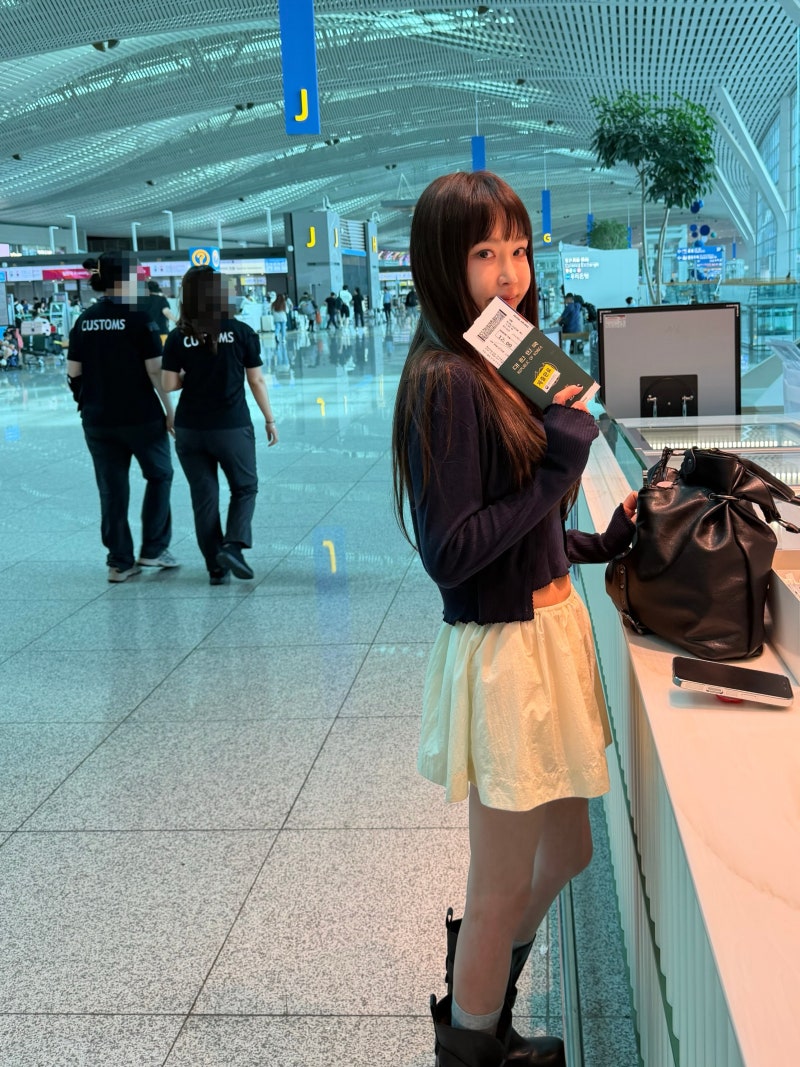
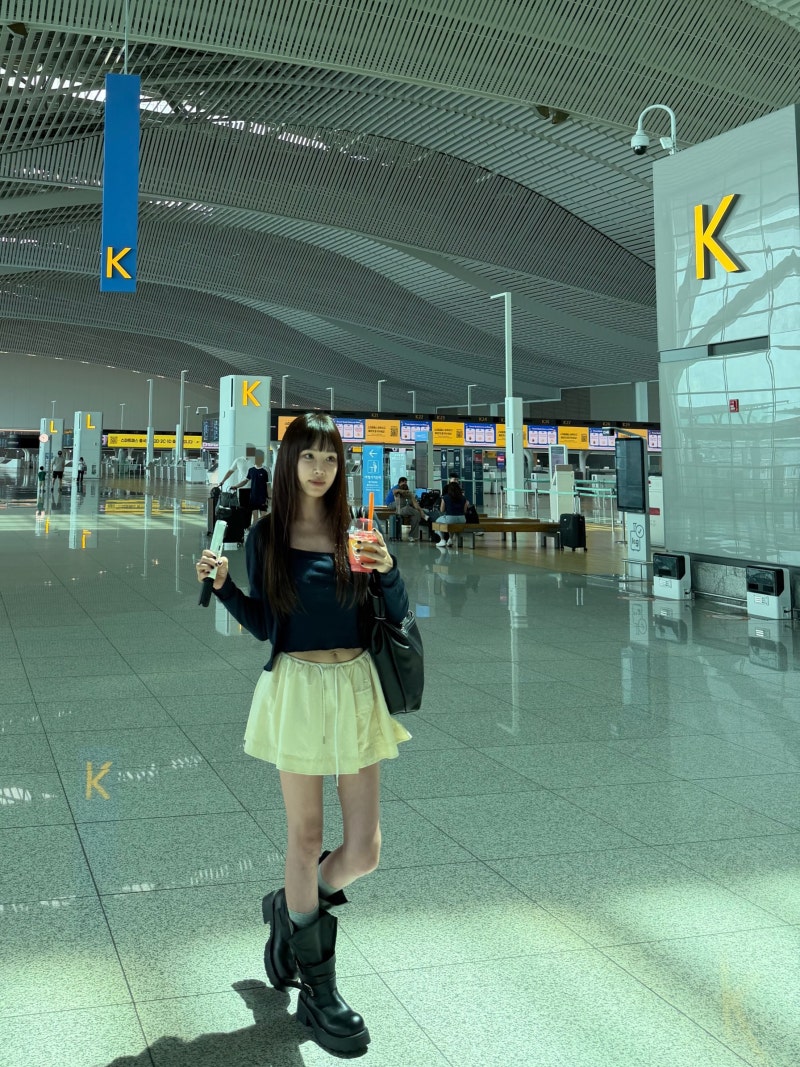
Third look is travel departure and she's working color contrast hard. Navy bolero cardigan with a crop top, then a bright turquoise bubble mini skirt. The bubble skirt is puffy, adorable, and on a 47-year-old it reads as young not juvenile because of how she's toned it down at the top.
Here's the color logic: top half dark (navy, black), bottom half bright (turquoise). This creates immediate visual movement and makes your legs read as longer because the eye follows the bright color down. She's added chunky boots at the bottom which grounds the whole thing—otherwise the cute skirt might read as too much. The boots make a statement: 'I'm cute but I'm not fragile.' That's exactly how a 47-year-old pulls off a bubble skirt.
The lesson: when you're using one color as your statement, limit it to one half of the body (top OR bottom). Use the other half to create anchoring contrast. A bright skirt with a bright top would be chaos. Bright skirt with toned-down top? Suddenly you're making a intentional choice, not accidentally dressing like a toddler.
RED BUTTON MINI DRESS: How Color Becomes the Accessory
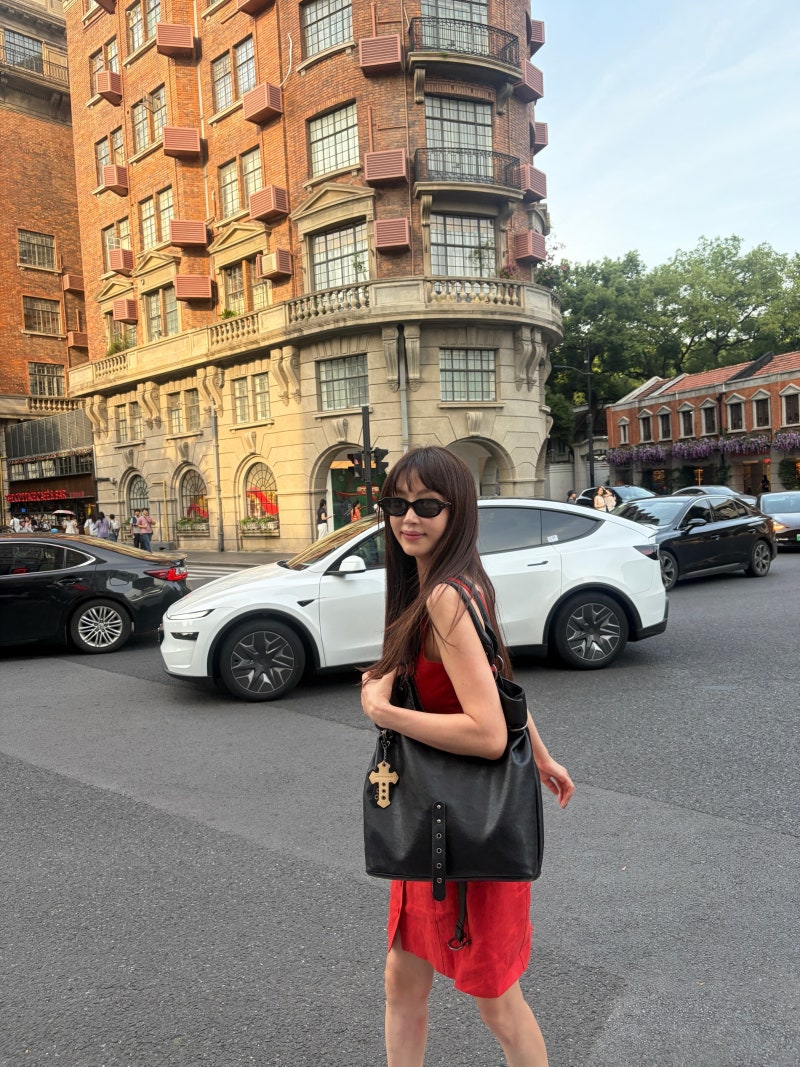
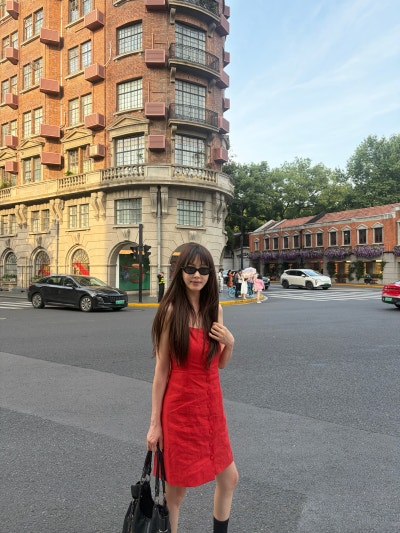
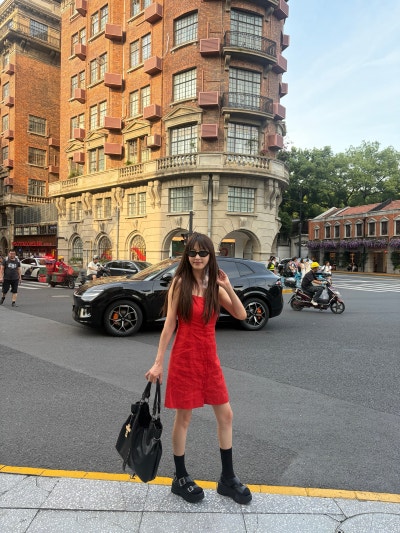
Final look is a red button-front mini dress with the buttons running straight down. The fabric sits close to the body, so the line is clear and the color is undeniable. Whole thing is red except for black accessories: black leather crossbody bag, black socks, black sunglasses. Everything else is neutralized so the red can be the star.
Red can absolutely read as too much, but she's muted everything else to a whisper. Black bag, black socks, black shades—it's like she's created a little dark cloud around the red dress so the red becomes the only thing you're looking at. That's the actual strategy: if you want to wear a bold color, strip everything else down to black or navy. No competing colors, no competing textures, just you and that one statement color.
The backdrop (these gorgeous old Shanghai streets) would normally be the story, but she dressed bold enough that she's the focal point. That's the opposite of the first look—there she was neutral in front of the car. Here she's the loudest thing on an already-interesting street.
What Connects All Four: The Actual Formula
When you zoom out from all four looks, Kang is working these rules consistently: one statement element (oversized blazer, jersey dress, bright skirt, red dress). Everything else gets toned down to support it, never compete with it. Color intensity gets balanced with silhouette—puffy skirt gets toned-down colors, statement color gets simple silhouette. Small accessories do the connecting work (matching colors top-to-bottom through hats, bags, shoes).
So if you're packing for a trip and want her energy, here's the system: pick one statement piece. Blazer, dress, or skirt—choose one. Build around it using the opposite strategy (simple with quiet outfit, bold with simple outfit). Accessories serve one job only: repeat one color throughout. One color in your hat, bag, shoes—that's it. Keep pieces clean and tailored. Don't overthink it.
She's basically proving that expensive things matter less than understanding how to balance the thing you're wearing. You don't need designer labels in four languages when you get the concept of 'one star, everything else supporting.'
"When your backdrop is dramatic, dress simply. When you want to be the focal point, dress bold."