Puff Sleeves for Everyone: How a 50-Year-Old Mom Wears What Her 20-Ish Daughter Does
The secret to wearing puff sleeves when you're worried about arm fat? The sleeves don't touch your arms. Here's how it works across three decades.
- Puff sleeves work because they create distance between fabric and arm—the gap is the camouflage
- Deep V-neck + vertical ribs = optical elongation of the whole upper half
- Swap shorts/jeans/ankle pants to adjust the fit for different life stages
Every summer, you stand in front of your closet and sweat through the same internal debate: sleeveless or covered up? You know sleeveless means your upper arms are going to be the focus, so you usually grab a thin layer to throw on top. But what if the sleeveless piece itself had the answer built in?
A New York embroidered puff-sleeve short-knit is that rare item that works at 20, at 35, and at 50. The only thing that changes is what you wear underneath it. Here's how to use it across three completely different life stages—and why the sleeve engineering is the whole trick.
① How puff sleeves actually hide arm size (it's about the gap, not the length)
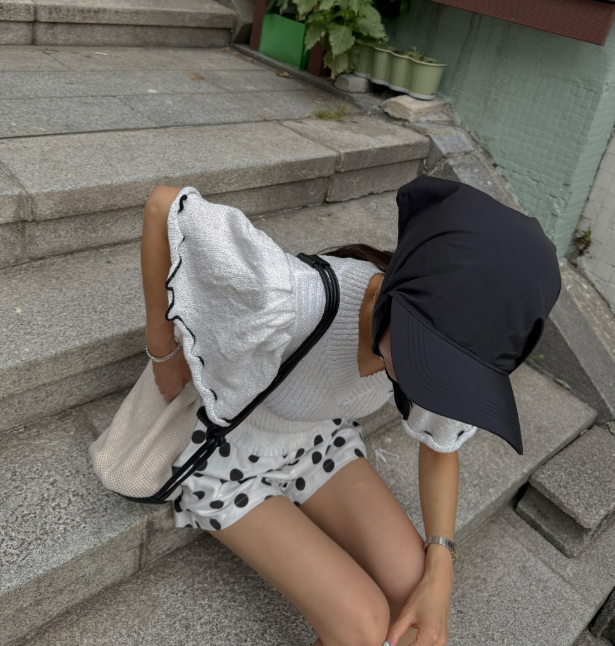
The core secret lives in *where* the sleeve ends. This isn't a full-length sleeve that goes to your wrist. It stops right above the elbow, meaning it covers the thickest part of your upper arm completely. But it doesn't stop there.
The sleeve is structured as a puff from shoulder down—it's wider at the sleeve cap than it is at the hem, so there's actual distance between the fabric and your arm. Your arm isn't hugging the fabric; the fabric is floating around it. That gap is everything. When there's space between cloth and skin, the eye can't measure your actual width. Puffiness = optical camouflage.
Then the hem ends in a wave-cut ruffle that ripples outward, and there's a black stitch line running along that edge. Your eye follows the edge line, not the arm inside it, so the reference point for "where does this arm end?" basically disappears.
Compare this to a fitted long-sleeve top, which is what most people reach for when they want coverage. Fitted long sleeves actually *trace* your arm shape, which means they show your exact silhouette. Loose and airy? That defeats the purpose of coverage. This puff structure is the answer: it covers + it creates distance.
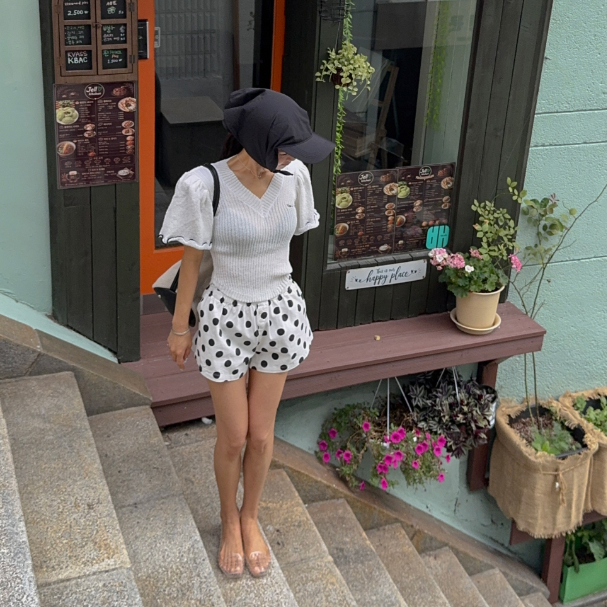
② The V-neck science: How one seam makes your face look smaller
The neckline is a deep V cut from a thick ribbed knit. That V runs down to roughly your breastbone, which creates a literal vertical line down the center of your body. Your eye reads that line as "length," so your whole upper half photographs as elongated. Especially if you have a shorter neck or wider shoulders, this V is working overtime—suddenly your neck looks longer and your face looks smaller.
The ribbed body fabric runs the same direction (vertical), with tiny ribs repeating down. Vertical lines = the eye traveling up and down, not side to side. When light hits those ribs (and this fabric has a soft silver sheen), the grooves catch light and create more depth, which makes the vertical lines even more pronounced.
The black embroidery sits high on the right side of the chest—not center, but *above* center. That pulls your eye upward, so you're reading the proportions from a higher starting point. Broad shoulders? Solved. Short torso? Same trick. Puffing sleeves make your arms look thinner, and a deep V makes your whole upper body read as longer and narrower.
③ Fabric tricks: Why it breathes even though it looks heavy
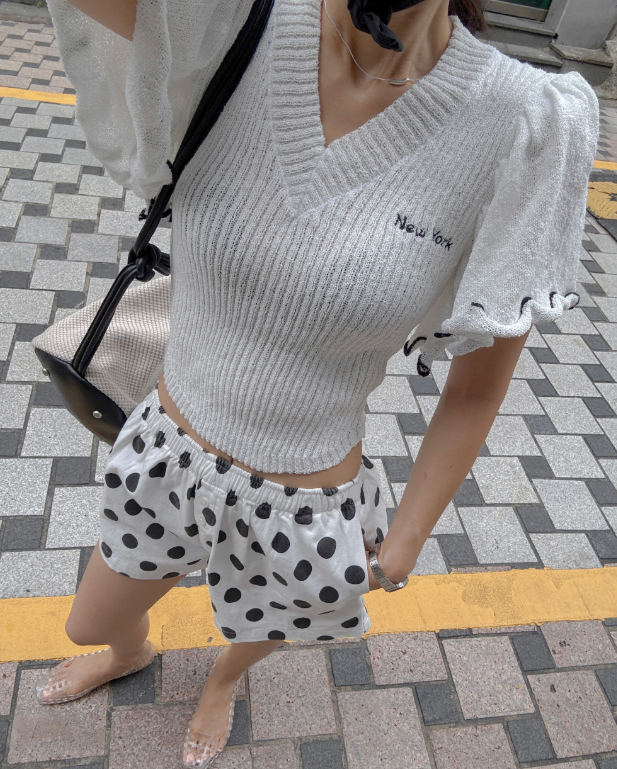
The body is knit in a tight, rippled rib texture, but the sleeves? Different story. The sleeves are cut from an eyelet fabric—literally tiny holes punched through. Air flows straight through. You get the visual of volume and coverage, but your arms don't trap heat. It looks substantial in photos but feels lightweight on the body.
④ How to style it at 20, 30, 40, and 50
The magic of this piece is the crisp waist seam that's gathered with a drawstring, which means every outfit reads "defined waist" no matter what you pair it with.
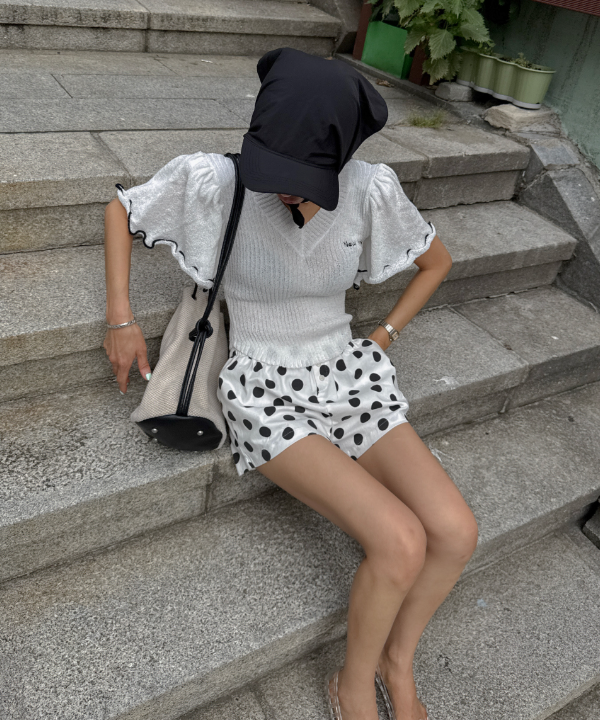
At 20: Pair it with white shorts that have a black dot pattern—playful and proportional. The shorts sit high on the waist via a shirred waistband, which pushes your legs up visually. Shorter leg = longer torso, but by raising the waistline, you move that proportion marker upward. You read taller. Go bare-legged into sandals or sneakers.
At 30: Stick with classic blue jeans or straight-line trousers in a neutral tone. The shirt is already saying something, so the bottom half should be quiet. Tall, clean lines. Monochromatic makes the fitted top read as the hero of the outfit.
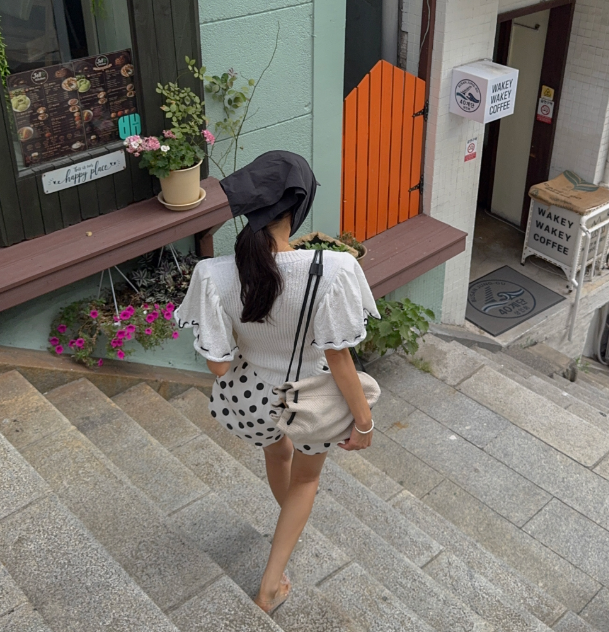
At 40+: Commit to a maxi or flowing wide-leg pant that grazes your ankle. The whole line from waist to floor becomes one unbroken vertical, which is the ultimate optical extension. Your top is short and defined; your bottom is long and lean. Together they stretch you out.
✦ Accessorize across all ages: Silver and black
Jewelry stays silver. A silver metal bracelet watch on one wrist, a thin silver chain bracelet on the other. Nothing in gold—the moment you mix metals, the clarity of your silhouette gets confused. The necklace, if you wear one, should be barely-there; the V-neck is already doing all the collarbone work.
On your shoulder: a cream canvas bag with a black leather round panel stitched on, finished with metal studs at the edges. The studs catch light and add detail without adding bulk. Wear it on a thin black strap, short across one shoulder, so there's an extra vertical line running down one side of your torso.
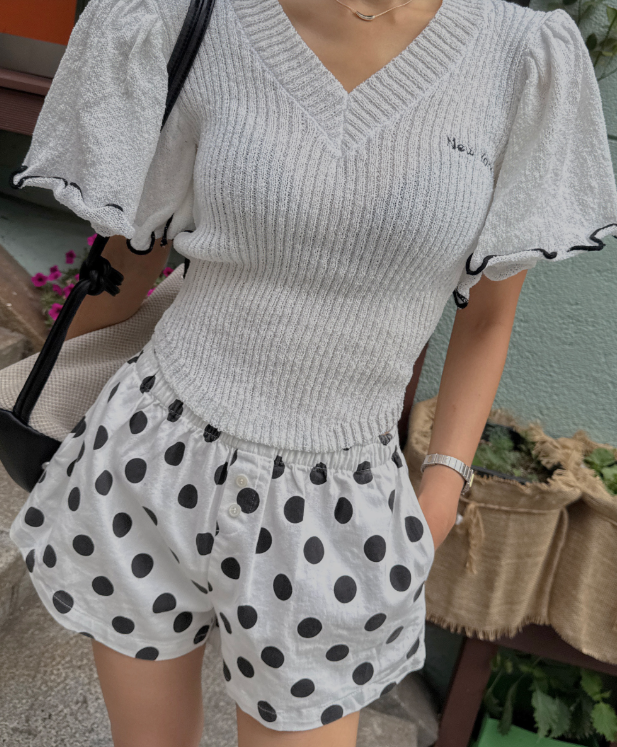
On your head: a black cap to complete the monochromatic black-and-cream palette. Silver jewelry. Done.
The genius of this formula is that a 20-year-old and a 50-year-old can wear the exact same piece and look age-appropriate simply because they change the bottom half and the shoe height. The engineering of the top itself—the V, the ribs, the puff, the eyelet—does the heavy psychological lifting across every decade.
"When there's space between cloth and skin, the eye can't measure your actual width. Puffiness equals optical camouflage."