
Stop Buying Clothes. Start Matching Them Right: Shin Min-ah's Five Summer Formulas
Famous for real-life beauty, she proves it's not about the pieces—it's about the proportions and that invisible thing called restraint.
- Oversized tops need slim bottoms—proportion is everything
- Statement outerwear means minimal jewelry and understated shoes
- White shirts work when fit is soft and details are edited ruthlessly

There's a difference between owning clothes and *wearing* them. You can have the perfect white shirt hanging in your closet for years without ever looking like Shin Min-ah wearing hers. The gap isn't about the piece; it's about one thousand tiny decisions: a neckline choice, sleeve roll, how you carry your wrist, what you don't accessorize with.
Her approach to summer style doesn't advertise itself. It whispers. A camel shawl with ivory slip dress, layers of thin gold rings, a chain bracelet catching light—the outfit lets your skin be the focal point, not the clothes. That's a philosophy, not a trend.

**The Camel Shawl Rule**
A camel-colored fringed shawl sounds basic until you see how she uses it. The fringe trails down, drawing the eye downward, which means your arms and shoulders read narrower. Throw it over an ivory slip dress and you're in a tonal gradient that photographs beautifully but, more importantly, *feels* like rest. Warm camel is forgiving—it works on warm skin tones and cool ones. Buy one shawl and your summer wardrobe just expanded by twenty invisible percent.
**White Shirt, Office Mode**
The trick to a white shirt at work is fit and editing. A slightly oversized cut (not obviously oversized, just soft at the shoulders) worn untucked, sleeves rolled to show your wrists—the thinnest part of your arm becomes visible, and suddenly proportions shift. You look slimmer. A thin earring, slimmed-down tote, black trousers that end right at your ankle. That's restraint. That's the whole formula: breathe space where you need it, definition where it counts.

**The Rib-Knit Slip Dress**
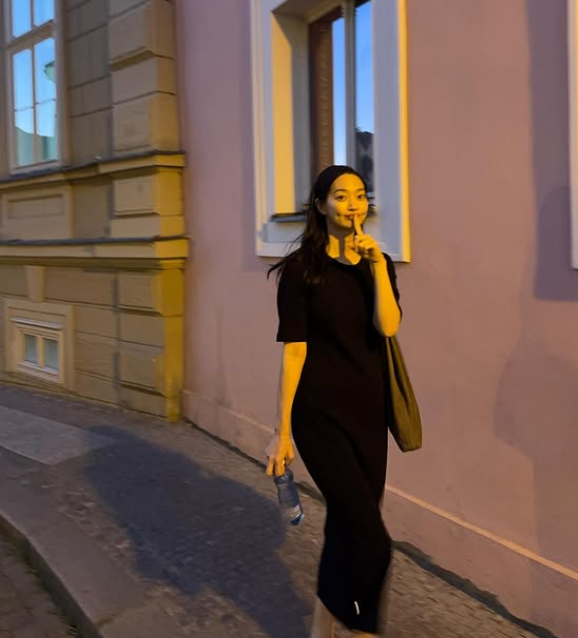
A short-sleeved rib-knit slip dress in black reads like a dare until you realize it's the opposite. Ribbed fabric pulls vision vertically, so even if you carry weight around your midsection (normal, human), the eye travels up and down, not across. Add a khaki shoulder bag and suddenly you're not thinking about concealing—you're actually *styling*. Flat shoes, a hair clip, and it works for afternoon wandering through museums or evening coffees. The midi length covers thighs, which is the real freedom here.

**The Red Tweed Jacket Moment**
One statement piece can rewrite your entire season. A red check tweed jacket is that piece. The texture reads expensive; the color lifts your face; the pattern is bold enough that what you wear under it becomes secondary. White button-up, black ribbon bow tie (yes, really—it reads fresh, not costume-y), black trousers, transparent horn-rim glasses. She's chic without effort because the jacket is doing the work. Wear it to the office, to events, to dates. It's the one investment that pays for itself in confidence.
**The Oversized Hoodie Maths**
Big sweatshirt, structured shorts, black socks cuffed, loafers that finish the line. The formula is: generous where it's hidden (torso), definition where it shows (legs). White base layer inside the grey hoodie so the color is balanced, not shadowy. This is the trying-too-hard filter reversed—it looks effortless because the proportions do the thinking for you.
The magic of this approach is that you're not hiding anything; you're *balancing* everything. That's a different practice entirely.
The common thread through all five looks is that they're not about having perfect pieces—they're about understanding your body, where proportion lives, and how restraint in accessories makes silhouette do the heavy lifting. That's not a luxury. That's a skill.
"The gap isn't about the piece; it's about understanding your body, where proportion lives, and how restraint in accessories makes silhouette do the heavy lifting."